Immersion Tin PCB Applications
An industry label is not enough to approve a surface finish. Start with the actual board construction, assembly process and product qualification requirements.
Compact electronics and control boards
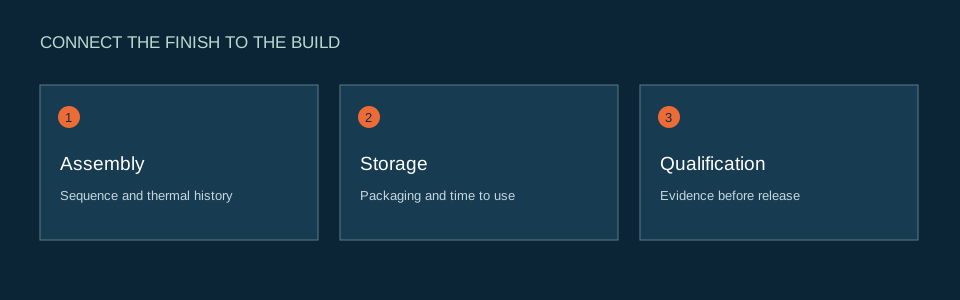
Fine-pitch assemblies benefit from a controlled relationship between land geometry, stencil printing and component placement. A flat finish can support that relationship, but paste selection and process control remain important. Record the smallest lands, package types and anticipated assembly sequence when comparing finishes.
Industrial controllers, instrumentation and compact consumer electronics can have very different storage and service conditions despite similar-looking PCBs. An enclosure exposed to humidity creates different questions from a controlled laboratory instrument. Define the environment and qualification plan instead of assuming that one finish suits every board in a product category.
Use the main engineering guide to identify finish considerations, then ask the assembly provider which conditions have already been qualified for the proposed construction.
Connectors and mixed assembly processes
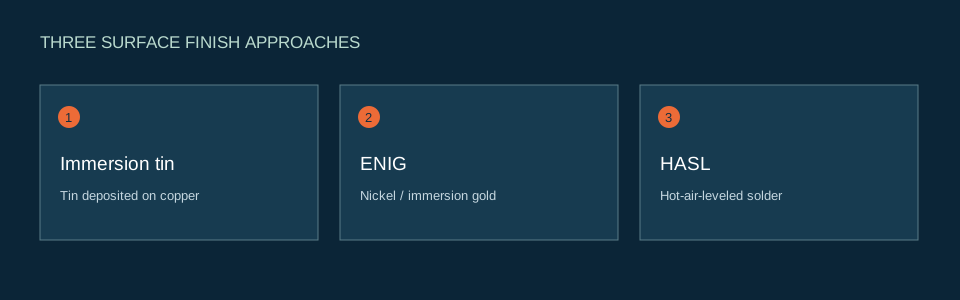
Press-fit connectors require particular attention to finished hole dimensions, plating and the connector manufacturer’s approved finish. Insertion and retention behavior must be evaluated using the intended board and connector combination. Do not substitute a general statement about tin’s solderability for connector qualification.
A board that combines reflow, selective soldering and mechanical interconnects should be assessed as a sequence. Include the highest thermal exposure and foreseeable rework. The condition of an unsoldered feature late in that sequence may differ from its condition when the bare board was received.
Repeatedly mated contacts and sliding interfaces introduce wear requirements. Treat them as a separate contact engineering problem. Finish choices intended primarily for soldering should not be adopted for these interfaces without supporting evidence.
High-reliability requirements need explicit evidence
Automotive, aerospace, medical and other demanding applications may impose customer-specific controls beyond a generic bare-board specification. Mentioning an application here does not claim that a particular factory, board or process is certified for it.
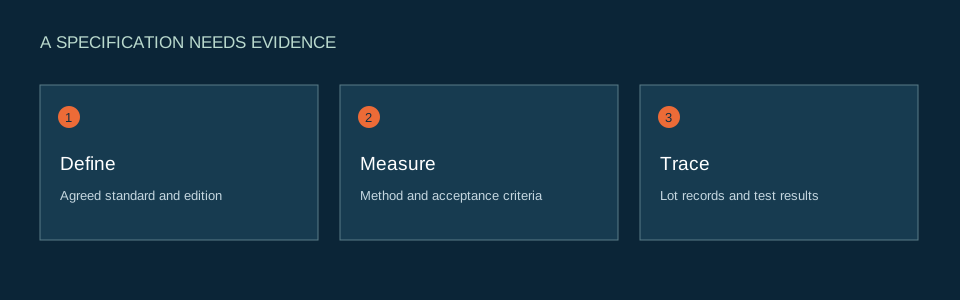
Define the applicable product requirements, traceability, change control, environmental testing and failure analysis expectations. Review standards and acceptance evidence and confirm which obligations belong to the fabricator, assembler and product owner.
Describe your application for a technical review. Share the operating environment, assembly history and any approved-material restrictions. If these inputs are not yet settled, explain the design stage so the response can distinguish provisional guidance from production requirements.
Apply this to your PCB project
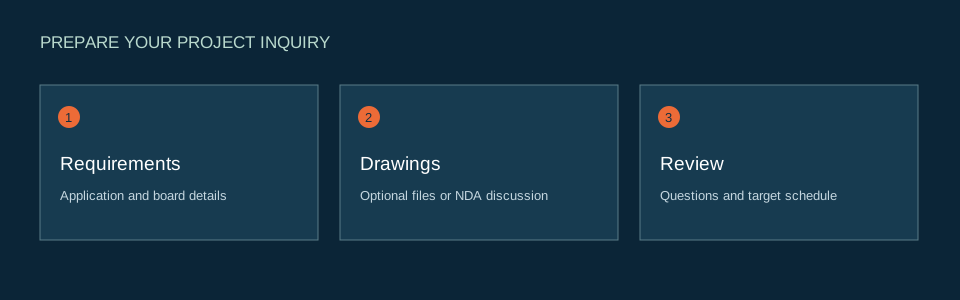
Share your design constraints, assembly sequence and finish questions. Drawings are optional.
Request a technical review ↗